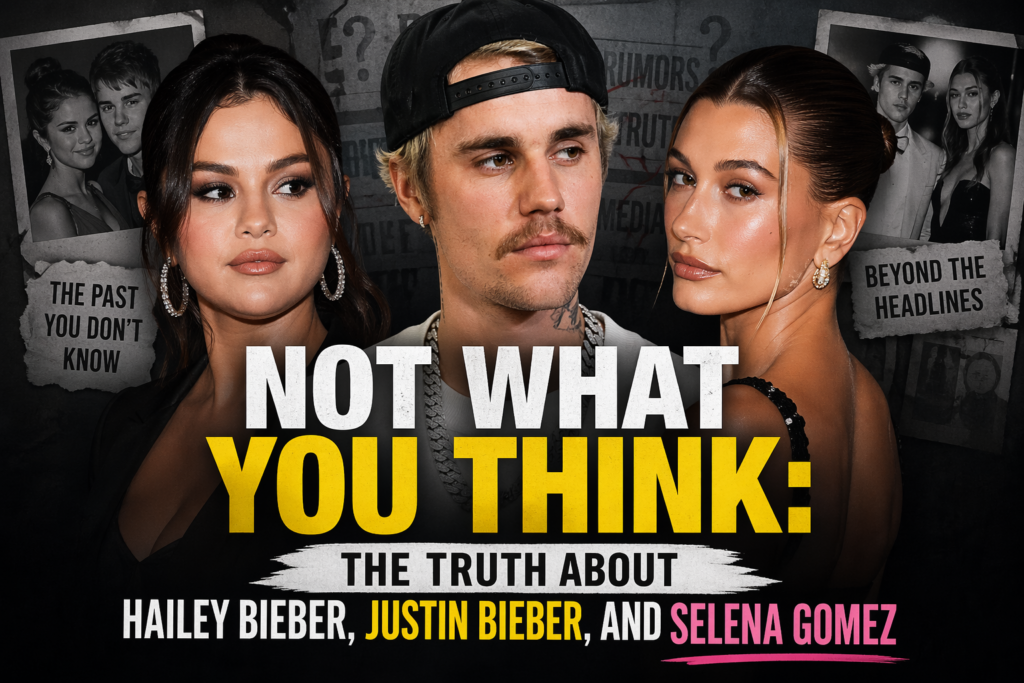
The relationship between Hailey Bieber and Justin Bieber has been turned into one of the internet’s most debated love stories. Add Selena Gomez into the timeline, and it becomes even more emotionally charged. But beyond viral narratives, what actually happened—and why do people interpret it so differently?
The “Obsession” Narrative
Online, Hailey’s early admiration for Justin is often labeled as a “decade-long obsession.” Old tweets, fan moments, and interviews are used as proof. But this framing ignores context.
She was a teenager during Justin’s peak fame—being a fan at that stage isn’t unusual. What makes this case different is proximity. Unlike most fans, Hailey eventually entered the same social and industry circles. Over time, admiration turned into familiarity, then friendship, and eventually something more.
Calling it “obsession” simplifies something that likely evolved naturally over years.
1. The “decade-long obsession” narrative
Hailey was a teenager during Justin’s early global fame. Like many people her age, she admired him publicly—tweets, fan moments, and being part of the same celebrity social circle later on. The internet often takes those early receipts and retrofits them into a single storyline: she always wanted him and planned for it.
That interpretation oversimplifies how admiration evolves. Teen fandom can turn into real-world proximity in celebrity circles. Over time, Hailey and Justin moved from acquaintances to friends, then dated briefly around 2015–2016, separated, and reconnected in 2018. That path—on/off, timing-dependent—is actually common in real relationships, just unusually visible here.
2. Was it “arranged”?
There’s no credible evidence that their marriage was arranged in any formal or orchestrated sense. What did happen is fast escalation: they rekindled their relationship in mid-2018 and were engaged within months, then married soon after.
Fast decisions in relationships can look suspicious from the outside, especially when fame, religion, and shared circles are involved. Both have spoken about faith and personal growth playing a role in their decision. That doesn’t make it arranged—it suggests alignment in values and timing, which can accelerate commitment.
3. The Selena Gomez factor
The shadow of Justin’s past with Selena is unavoidable. Their relationship was highly public, emotionally intense, and long-running. When Justin married Hailey not long after fully closing that chapter, fans naturally connected the dots.
But the “conflict” is largely amplified by fan culture and social media. There’s little evidence of ongoing personal hostility between Hailey and Selena themselves. Most of the tension exists in narratives created around them:
- Fans projecting loyalty to one side
- Comparing timelines and emotional “ownership”
- Reading meaning into coincidences (songs, posts, appearances)
In reality, relationships end, people move on, and timelines overlap in messy, human ways.
4. Why fans read it differently
This story hits a nerve because it combines three powerful dynamics:
- Parasocial attachment: Fans feel personally invested in Justin’s earlier relationship
- Narrative closure: People want a clean ending, not overlapping chapters
- Digital evidence: Old tweets, photos, and clips create a “detective story” effect
So the same facts can be interpreted in two extremes:
- Romantic destiny: friends → right timing → marriage
- Calculated pursuit: long-term interest → strategic patience → outcome
The truth likely sits in between: evolving feelings, proximity, timing, and imperfect decisions.
5. A more grounded interpretation
Instead of obsession or arrangement, a more human reading is:
- Hailey admired Justin early on (normal for her age and context)
- They entered the same social world and built a real connection
- Timing didn’t work at first, then it did
- Justin made a quick, decisive commitment during a period of personal change
- Fans filled in emotional gaps with their own narratives
Final thought
The internet prefers clean, dramatic labels—obsession, arranged, rivalry. Real relationships are rarely that simple. The story of Hailey and Justin is less about a master plan and more about timing, proximity, personal growth, and the chaos of public life being interpreted by millions.