On November 29, 2020, during the Bahrain Grand Prix, Formula 1 driver Romain Grosjean experienced one of the most harrowing crashes in the sport’s modern history. The incident, which occurred on the opening lap, sent shockwaves through the motorsport world and highlighted the remarkable advancements in F1 safety that allowed Grosjean to walk away from a fiery wreck that could have been fatal in earlier eras.
The Crash
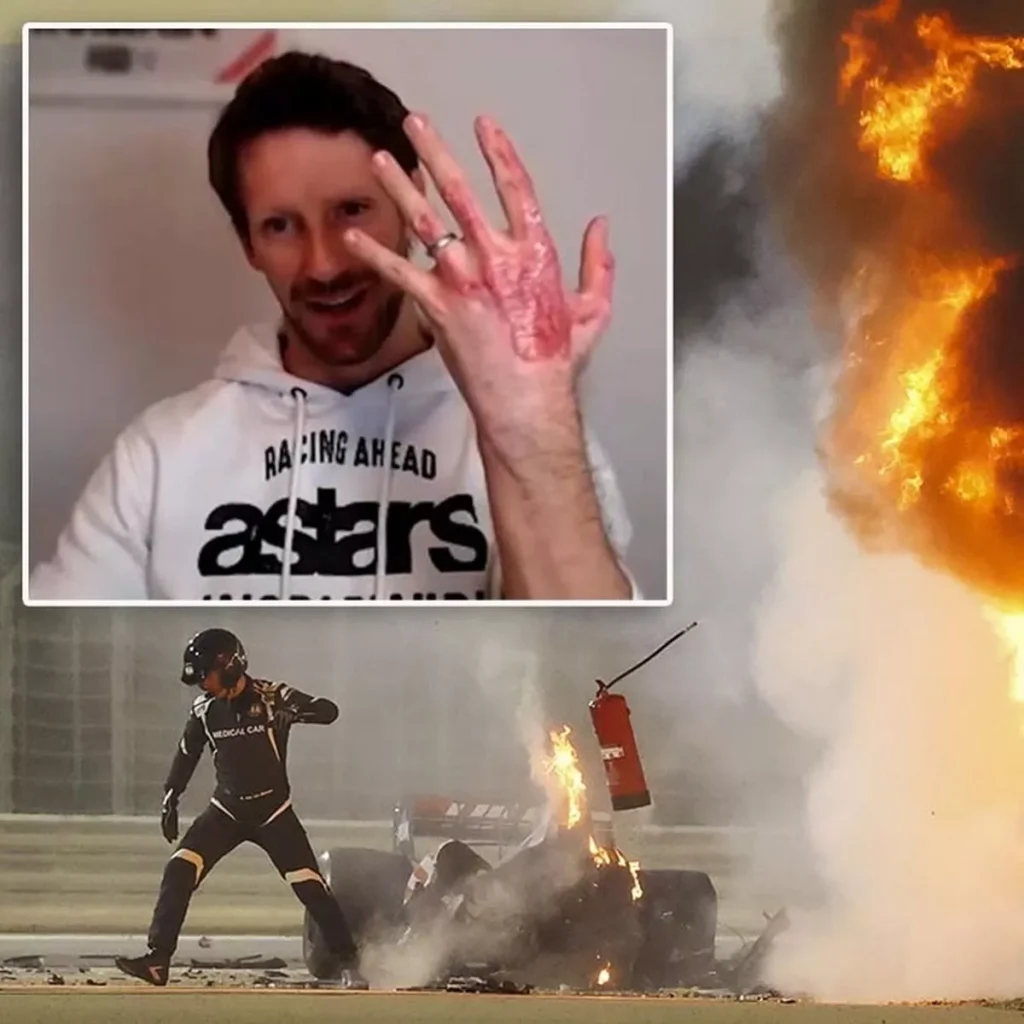
Grosjean, driving for the Haas F1 Team, started the race from 19th on the grid. As the pack jostled for position exiting Turn 3, Grosjean’s car made contact with the AlphaTauri of Daniil Kvyat. The slight collision sent Grosjean’s VF-20 veering right at approximately 192 km/h (119 mph), striking a triple-guardrail barrier at a near head-on angle with a force of 67G. The impact was catastrophic: the car split in half, with the front section, including the driver’s cockpit, piercing through the barrier and erupting into a massive fireball due to a fuel leak from the tank’s safety bladder and engine fuel supply connection.For 28 agonizing seconds, Grosjean was trapped in the burning wreckage, surrounded by flames that reached temperatures between 800 and 1,000°C. The Formula 1 broadcast initially cut away from the scene, and fans, teams, and fellow drivers feared the worst, given the intensity of the blaze and the severity of the crash.
The Escape
Despite the dire circumstances, Grosjean’s survival was a testament to his resilience and the sport’s safety innovations. Inside the cockpit, Grosjean remained conscious, though his left foot was briefly trapped under the pedal, and the headrest initially pinned him down. He later recounted thinking of his three children—Sacha, Simon, and Camille—and his determination to survive for them. “I thought about Niki Lauda, his accident, thought it couldn’t end like this,” Grosjean said, referencing the legendary driver’s fiery 1976 crash. Refusing to give up, he twisted his body, broke the headrest with his helmet, and freed his foot, emerging from the flames after wrenching himself through the cockpit.Grosjean leapt over the damaged barrier, shaking his burning hands in pain and missing one shoe and glove. He was immediately aided by track marshals and Dr. Ian Roberts, the F1 medical car driver, who braved the heat to assist him. Alan van der Merwe, the medical car driver, sprayed Grosjean with a fire extinguisher as he was guided to safety. Grosjean was airlifted to Bahrain’s Defence Force Hospital, where he was treated for second-degree burns on his hands and ankles but, miraculously, sustained no broken bones. He was discharged three days later.
The Role of Safety Innovations
Grosjean’s survival was no miracle but the result of decades of safety advancements in Formula 1, many of which were accelerated after the tragic deaths of Ayrton Senna and Roland Ratzenberger in 1994. Key technologies that saved his life included:
- The Halo Device: Introduced in 2018 despite initial resistance from drivers, including Grosjean himself, the titanium halo protected his head from the guardrail’s impact. Grosjean later called it “the greatest thing that we’ve brought to Formula 1,” crediting it with saving his life.
- The Survival Cell (Monocoque): The carbon-fiber safety cell, reinforced with Kevlar, remained intact despite the car splitting in half, providing Grosjean a protected space to survive the initial impact and fire.
- HANS Device: The Head and Neck Support device, mandatory since 2003, prevented catastrophic neck injuries during the 67G impact.
- Fireproof Clothing: Upgraded for the 2020 season, Grosjean’s Nomex suit and gloves extended his protection against the flames, though his hands still suffered burns. The suit’s fire resistance, improved from 10 to 20 seconds, was critical during the 27 seconds he spent in the blaze.
- Rapid Response: The medical car arrived within 10 seconds, and marshals quickly deployed fire extinguishers, creating a window for Grosjean’s escape.
The FIA’s investigation later revealed that the fuel tank’s inspection hatch and engine fuel supply connection were dislodged, causing the fire. The barrier’s failure to absorb the impact also raised concerns, prompting further safety reviews.
Aftermath and Legacy
The crash marked the end of Grosjean’s Formula 1 career, as he was already set to leave Haas at the end of 2020. He transitioned to IndyCar in 2021, where he achieved a pole position and multiple podiums, and later moved to the_^sportscar racing with Lamborghini in the IMSA SportsCar Championship.Grosjean’s survival left a lasting impact on the sport. The charred remains of his Haas VF-20 were displayed at Formula 1 exhibitions in Madrid and London, serving as a stark reminder of the sport’s dangers and the effectiveness of its safety measures. Grosjean himself reflected on the crash’s profound effect on his outlook, emphasizing the importance of living life fully and prioritizing his family.The incident underscored the bravery of F1 drivers, marshals, and medical teams, as well as the sport’s relentless pursuit of safety. Posts on X captured the awe and relief of fans, with one user describing Grosjean’s escape as “the most One Piece shit I’ve ever seen in real life,” likening it to a dramatic anime moment. Another called it “an extreme sad for the people at F1” that turned into a story of survival.Grosjean’s walk through fire remains a defining moment in Formula 1 history, a testament to human resilience and engineering triumph in the face of near-certain tragedy.